Key takeaways
- Compare like for like: same product, quantity and trade terms.
- Look at the landed cost per unit, not only the quoted price.
- Check MOQ, lead time and payment terms — they change the real deal.
- Order samples from your best two or three before deciding.
- Reply to every supplier — even a short “no thank you” keeps relationships open.
Where quotations arrive
Quotations for your buy requirements and replies to your inquiries arrive in My Business → Messages, and you get an email notification. Open a requirement in My Requirements to see all its quotations together. New to the inbox? Read How Messaging Works.
What a quotation contains
| Item | What to check |
|---|---|
| Unit price & currency | Price per piece, metre or kg — and what it includes (fabric, trims, printing, packing) |
| Price unit | Per piece, per set, per dozen, per kg — make sure all quotes use the same unit |
| Trade terms | EXW, FOB, CFR, CIF or DDP — decides who pays freight, insurance and duties |
| MOQ | Per order, per style or per colour |
| Lead time | Sampling time plus bulk production, and whether shipping is included |
| Payment terms | L/C, T/T with deposit, or other — and when each payment is due |
| Validity | How long the price is valid |
| Attachments | Spec sheet, catalogue, test reports or certificates |
Trade terms in one table
Under Incoterms® 2020 rules, the trade term decides who pays for what and when the risk passes to you:
| Term | Seller pays | Risk passes to buyer |
|---|---|---|
| EXW | Goods ready at seller’s premises | At seller’s premises |
| FOB | Export clearance and loading on board at origin port | When goods are on board at origin |
| CFR | FOB costs + sea freight to destination port | When goods are on board at origin |
| CIF | CFR + minimum cargo insurance | When goods are on board at origin |
| DDP | Everything to your door, including import duties | At your named destination |
Learn more in Incoterms for Textile Buyers.
Compare the landed cost
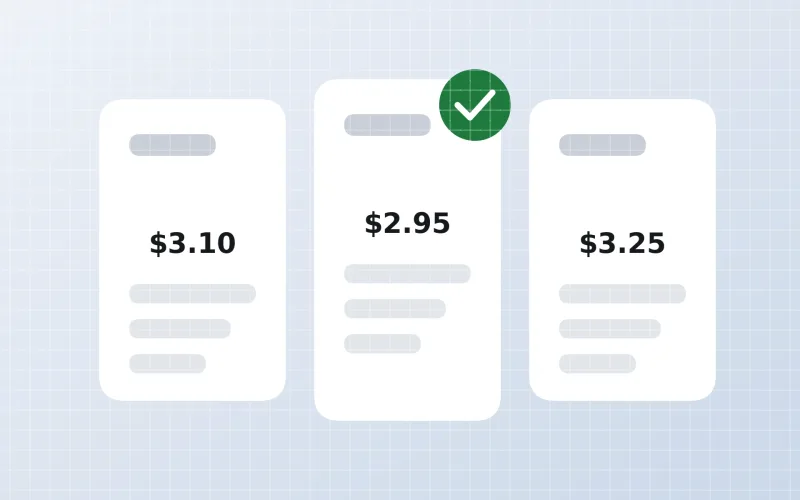
A low FOB price can cost more than a higher CIF price once freight, insurance and duties are added. Use this calculator with your own numbers:
| Per unit | Supplier A | Supplier B | Supplier C |
|---|---|---|---|
| Quoted price | 2.95 | 3.10 | 3.40 |
| Trade term | FOB | FOB | CIF |
| Freight | 0.18 | 0.15 | 0 |
| Insurance | 0.02 | 0.02 | 0 |
| Import duty % | 12 | 0 | 12 |
| Landed cost | 3.53 | 3.27 | 3.81 |
The calculator applies duty to price + freight + insurance (the CIF value, as used in the EU); some countries, such as the United States, apply duty to the FOB value. Duty rates depend on the product, origin and destination, and some origins have preferential rates — check with your customs broker.
Payment terms
| Term | How it works | For the buyer |
|---|---|---|
| L/C at sight | Your bank pays when the supplier presents the agreed shipping documents | Strong protection; bank fees and paperwork |
| T/T 30/70 | 30% deposit, 70% before shipment or against documents | Common; combine with a pre-shipment inspection |
| T/T in advance | Full payment before production | Highest risk; avoid for new suppliers |
| D/P | Documents released when you pay through the bank | Middle ground; less common for first orders |
More in Payment Terms: L/C vs T/T.
Score your suppliers
Price is one factor. Rate each shortlisted supplier from 1 to 5:
| Factor | Look for |
|---|---|
| Landed cost | From the calculator above |
| Sample quality | Matches your spec, good finishing |
| Lead time & capacity | Realistic, with capacity for your volume |
| Communication | Fast, clear and complete answers |
| Trust signals | Verified, certificates confirmed with the issuer, references — see Verified & Certificates |
Questions to ask before you decide
- Is the price valid for my full quantity and all colours?
- What exactly is included — packing, labels, testing?
- What is the sample cost and is it refundable on bulk order?
- Which factory will produce my order?
- Can you share a recent test report for this fabric?
Decide and reply
Reply and negotiate in the same message thread (messaging tips). Approve a sample, confirm price, quantity, delivery, trade and payment terms in writing, and agree how goods will be inspected. Reply to suppliers you didn’t choose — they may be right for your next order.
Frequently asked questions
How many quotations should I compare?
Three to five quotations usually give a good view of the market. Order samples from the best two or three.
Why are quotations so different in price?
Differences in fabric quality, trims, packing, trade terms, MOQ and what is included. Ask each supplier to confirm what the price covers.
What is landed cost?
Landed cost is the total cost of a product delivered to your warehouse: the quoted price plus freight, insurance, import duty and other charges.
Should I always choose the cheapest supplier?
No. Compare landed cost, sample quality, lead time, communication and trust signals such as Verified and confirmed certificates.
How do I decline a quotation?
Reply in your Textilepages inbox with a short thank-you message. Suppliers appreciate it and may offer better terms next time.
This guide explains how Textilepages works and common trade practice. It is general information, not legal, financial or customs advice.