Key takeaways
- Add each site with ownership, floor area in sq ft and number of workers.
- State monthly capacity per product line, with lead time.
- Show what you do in-house and what you outsource.
- List key machinery and your quality steps.
- Switch on Taking new orders when you have free capacity.
Why buyers check capacity
Factory and capacity details tell a buyer whether you can produce their volume, in their time frame, with the right processes. Brands and importers check this before they ask for a quotation.
Sites
| Field | Example |
|---|---|
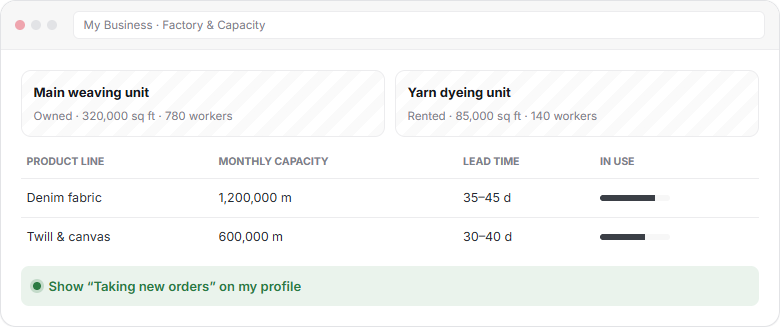
| Site name | Main weaving unit |
| Location | Gazipur, Dhaka |
| Owned or rented | Owned |
| Floor area | 320,000 sq ft |
| Workers | 780 |
| Photos | Floor, machines, warehouse |
Add every site that makes your products, including dyeing, printing or finishing units. Use square feet for floor area.
Monthly capacity
Enter output per product line, not one total. A buyer of twill wants to know your twill capacity, not your whole mill.
| Product line | Monthly capacity | Lead time |
|---|---|---|
| Denim fabric | 1,200,000 metres | 35–45 days |
| Knit T-shirts | 300,000 pieces | 45–60 days |
| Terry towels | 180 tons | 40–50 days |
Processes
Mark each step as in-house or outsourced. Buyers trust suppliers who are open about this.
| Product line | In-house | Outsourced |
|---|---|---|
| Spinning | — | ✓ |
| Weaving / knitting | ✓ | — |
| Dyeing | ✓ | — |
| Printing | — | ✓ |
| Cutting and sewing | ✓ | — |
| Washing and finishing | ✓ | — |
Machinery
List the key machines with type, brand and number of units, for example “Air-jet looms · Toyota · 220 units” or “Flatlock machines · Pegasus · 120 units”. Machinery suppliers can also show the machines they sell as products. See Add products that get inquiries.
Quality and people
- Quality steps: incoming fabric checks, inline and final inspection, the AQL level you work to.
- Lab tests: in-house lab or the outside labs you use for colour fastness, shrinkage or GSM.
- People: total workers, merchandisers, quality team size and any technical staff.
- Social and safety: audits you have passed. List them as certificates in your profile.
Taking new orders
Turn on Taking new orders when you have free capacity. A green label then shows on your profile. Turn it off when you are fully booked, so buyers are not disappointed.
No factory of your own?
Traders, wholesalers and buying houses can still fill this section. Describe the partner factories you work with, the categories they cover and your role, such as sampling, quality control or shipment follow-up. Do not present a partner’s factory as your own.
Frequently asked questions
What capacity should I enter?
Enter your realistic monthly output for each product line, such as metres of fabric or pieces of garments. Use what you can deliver in a normal month, not your best month.
Should I use square feet or square metres for floor area?
Use square feet on Textilepages. It keeps profiles easy to compare for buyers in every market.
What does Taking new orders mean?
It is a switch that shows buyers you have free capacity now. Turn it on when you can accept new orders and off when you are fully booked.
I am a trader without a factory. What do I fill in?
Describe the partner factories you work with, the categories they make and the services you add, such as sampling and quality control. Be clear that the factories are partners.
Do I need to list every machine?
No. List the key machines that show your capability, with type, brand and number of units. That is enough for most buyers.
This guide explains how Textilepages works and common trade practice. It is general information, not legal, financial or customs advice.